
Jade Pruett is the founder of HelloSEO, an SEO agency focused on therapy practices. She is also the newest cofounder of MetaMonster.
In late 2024, I was completely burnt out. On the outside, HelloSEO looked great. I had been running my SEO agency on my own for four years, the business was scaling nicely, and we were making more money than ever.
Internally, I was exhausted. I had no real systems. I was doing almost all of the client work myself, and important tasks kept slipping through the cracks. At one point, I downloaded a project-management tool that was supposed to help me organise my workload. Instead, it kindly informed me that I literally did not have enough hours in the week to complete everything my clients needed.
Honestly, it was validating. The problem was not that I needed a better to-do list. The way I was running the agency had become mathematically impossible.
I spent a lot of time thinking about what I actually wanted from HelloSEO. I still wanted the agency to grow. I did not feel like I was finished building it, but I had no idea how to reach the next level.
I had never managed employees before. I was already so deep in the weeds that I could not imagine slowing down long enough to hire someone, train them and document all of the processes that existed mostly inside my head.
I needed to stop being the person who personally completed every SEO task. But I was also terrified that handing the work off would mean sacrificing the quality that had made the agency successful.
Fast-forward to 2026, and HelloSEO looks wildly different.
- The agency has more than doubled in revenue.
- I have one full-time employee who still has room to take on more.
- I spend less than an hour a day working directly on client deliverables.
- Work that once took place sporadically over several weeks can now be completed during the first working session with a new client.
Hiring the right person was an essential part of that transformation. But MetaMonster gave me the operating system I needed to actually delegate the work.
Over the last year, MetaMonster has become indispensable to my workflow and my team. We use it for every client, every day.
It has helped me:
- Turn keyword research, metadata and schema creation from a scattered, multi-week onboarding process into a repeatable workflow that can begin within the first hour
- Delegate execution without handing my employee a watered-down version of my process
- Build my expertise into editable prompts, content rubrics and voice-and-tone guidelines
- Complete tedious but valuable tasks like internal linking and alt text instead of skipping them when capacity is tight
- Show clients exactly what we changed through exports, comparisons and clear reporting
- Use shareable website reports to generate leads and build trust before a prospect ever gets on a sales call
MetaMonster did not remove the need for SEO expertise. It made that expertise repeatable, teachable and scalable.
Here is how we use it to run HelloSEO.
How MetaMonster Streamlines Client Onboarding
At HelloSEO, we primarily work with small businesses, including local and national brands. Our first priority is making sure the foundations are solid.
Are the right pages targeting the right keywords? Is the site indexed properly? Do the metadata and on-page signals accurately describe what the business offers?
Before MetaMonster, answering those questions across an entire website required a significant amount of manual research, documentation and implementation. It was easy for the highest-priority pages to get attention while long-tail service pages remained unfinished for months.
Now, we can create the strategic foundation for an entire site much earlier in the client relationship.
Keyword Research and Page Mapping
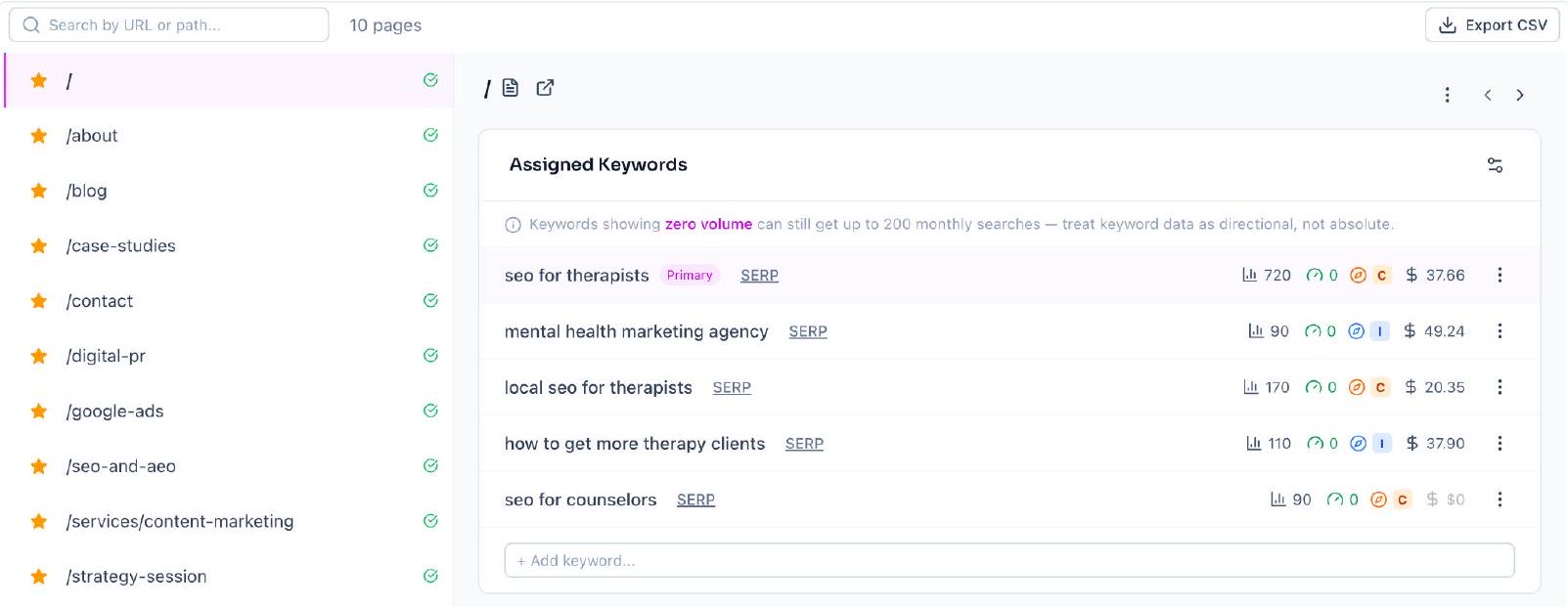
The first thing we do is enter the client’s website into MetaMonster and generate suggested target keywords for each page.
MetaMonster uses the context of the existing website to understand what the business offers and which phrases may be relevant. Because its prompts are editable, we can also add specific instructions based on the client’s positioning.
For example:
This business is niching down to serve therapists. Make sure the keyword recommendations reflect that audience.
Or:
Prioritise keywords with a difficulty score below 20.
It is still important to review every recommendation and confirm that the keyword matches the client’s goals, services and search intent.
The value is not that MetaMonster replaces strategic judgment. It gives us a much stronger and faster starting point for applying that judgment across an entire site.
I often find that it identifies phrasing and semantic nuances I might not have considered immediately. For example, as someone who lives on the East Coast, it did not initially occur to me how often people in San Francisco would search for services using the phrase “Bay Area.”
MetaMonster surfaced that regional language immediately. That gave us an opportunity to account for how the client’s actual audience searched rather than relying entirely on our own assumptions.
Meta Titles and Descriptions
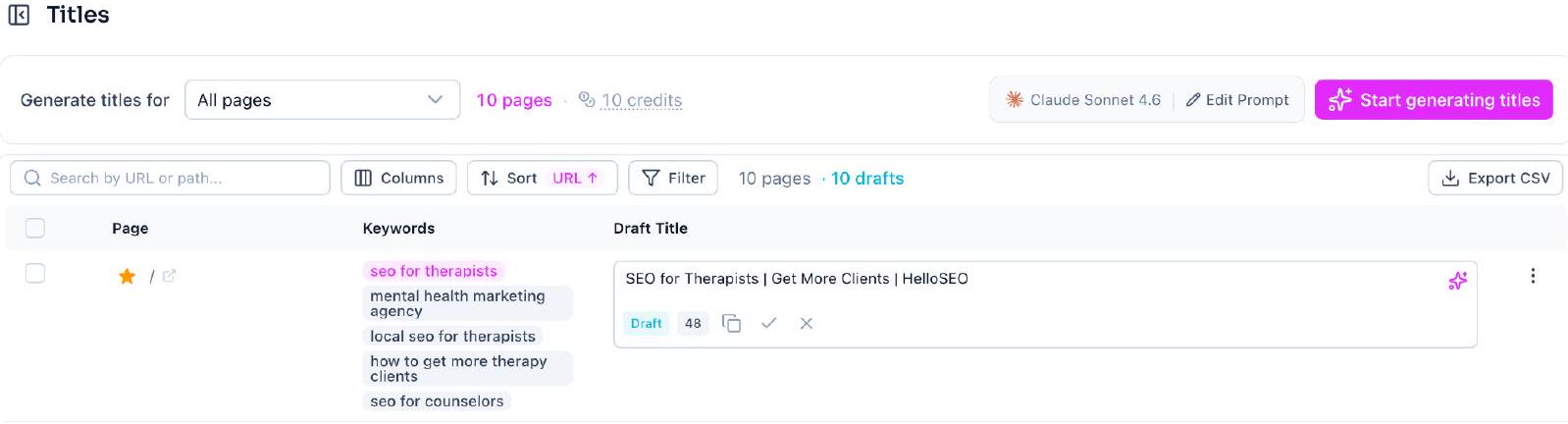
Once we have approved the keyword strategy, we can generate titles and descriptions for each page.
Again, the prompts are customizable. If we have a particular structure, tone or style we want to follow, we can build those instructions into the workflow.
This is one of the clearest examples of how MetaMonster helps me delegate without losing quality. My employee is not staring at a blank spreadsheet and guessing how I would write 40 title tags. She is working within a system that already reflects our standards.
We can then use sandbox mode to create an export containing the keywords and proposed metadata for every page on the site.
The export includes side-by-side comparisons, allowing clients to see their current metadata alongside our proposed changes.
Without MetaMonster, creating that document manually could take days. Now, we can produce a clear, client-ready deliverable quickly, collect approval and move into implementation without weeks of back-and-forth.
For WordPress websites, we can publish the approved changes directly to the CMS. For other platforms, the export creates a clear implementation task that can be handed to a junior SEO or website administrator.
The larger business impact is that foundational optimization no longer depends on me personally finding time to complete every page. The process is documented, reviewable and easy to assign.
How We Complete the SEO Work That Often Gets Skipped
Some SEO tasks are important but exceptionally easy to postpone. They are not always exciting. They may not feel urgent. When an agency is overloaded, they are often the first things to disappear from the schedule.
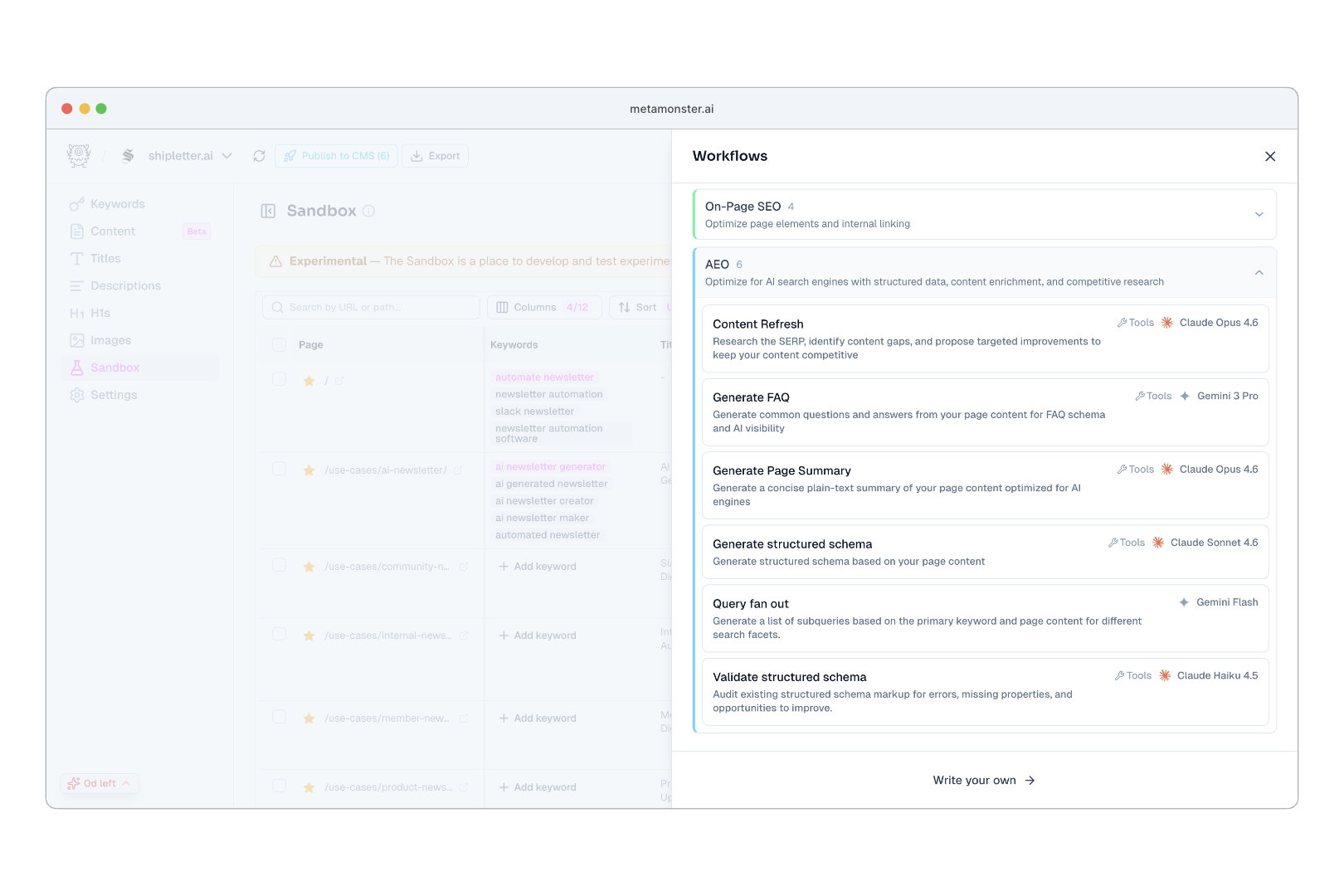
MetaMonster helps us turn those “we should eventually do that” tasks into part of our standard delivery process.
Schema
We have an experimental schema generator inside the MetaMonster sandbox, and I am obsessed with it. We use it for every client.
Instead of treating schema as a specialised project we may or may not have time to complete, we can build it into the normal optimization workflow and review the output before implementation.
Alt Text
MetaMonster can generate alt text across a site, particularly efficiently for WordPress clients. My favourite part is not only the ability to complete the work faster. It is also the reporting. We can export the changes and show clients exactly what has been completed. MetaMonster does not just help answer the question, “How do we get all of this work done?” It also helps answer the age-old client question: “What have you even been doing?”
Internal Linking
Internal linking may be one of the most boring and easiest-to-ignore tasks in SEO, but it can have an enormous impact on how users and search engines navigate a website.
MetaMonster offers basic and advanced internal-linking workflows. In sandbox mode, it uses the keywords assigned to each page to find relevant relationships across the site.
It can recommend:
- Which pages should link to one another
- Where the link could naturally be placed
- Which anchor text may be appropriate
- Why the connection makes sense
This turns internal linking from an open-ended scavenger hunt into a clear implementation plan. It also creates a strong reporting document. Instead of simply telling clients that we improved their internal-linking structure, we can show them the specific opportunities we identified and the changes we made.
The goal is not merely to do more work. It is to make sure the high-value work that agencies often postpone actually becomes part of the client experience.
How MetaMonster Helps Me Delegate Without Sacrificing Quality
This is the part that changed my role inside HelloSEO. Before I hired an employee, much of the agency’s quality control depended on me personally completing each task.
I knew how I wanted keyword research conducted. I knew what made a good title tag. I knew how to assess a piece of content. But much of that knowledge was instinctive and undocumented.
That creates a difficult trap for agency founders: the better you are at the work, the harder it can feel to hand it off.
MetaMonster helps us turn those instincts into a visible process. Its editable prompts allow us to define how tasks should be completed. Its voice-and-tone guidance helps maintain consistency. Its content rubric gives my employee a framework for evaluating work rather than relying on vague instructions like “make it better.”
My employee can now own much of the execution. I review the strategy, address unusual cases and make final decisions when needed. I no longer have to create every deliverable from scratch in order to feel confident about the quality.
That is a meaningful difference. I have moved from being the agency’s primary production worker to being the person who oversees the system.
How We Use MetaMonster for Content Optimization
The content tool is MetaMonster’s bread and butter. My co-founder Andrew originally began developing it after interning at HelloSEO and seeing how antiquated and difficult many existing content-optimization tools were to use.
We did not want to build another tool that produced a giant list of phrases to stuff awkwardly into an article. We wanted to create something that reflected how strong SEO content is actually evaluated today.
MetaMonster’s content tool:
- Takes your target keyword
- Performs a SERP analysis to study competing pages
- Identifies relevant keywords, entities and topics appearing across the results
- Evaluates the existing page
- Provides specific suggestions for improving the content
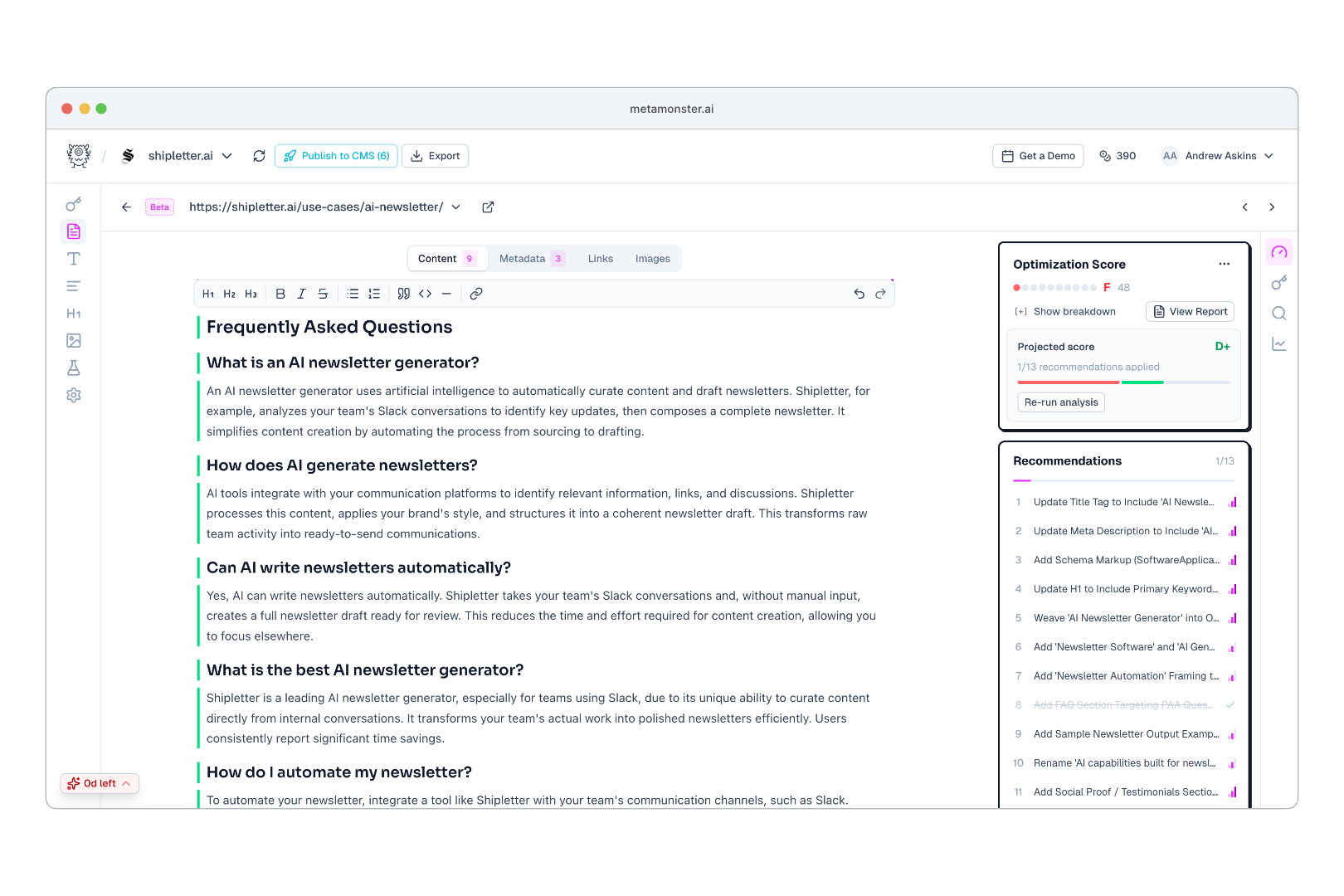
It looks at much more than keyword frequency. The rubric was developed with input from a real SEO expert (me) to evaluate the factors that influence how competitive, useful and credible a page may be in modern search.
The rubric grades content across 33 factors, including:
- Competitive position
- Keyword gaps
- SERP features
- SEO fundamentals
- E-E-A-T signals
- Writing quality
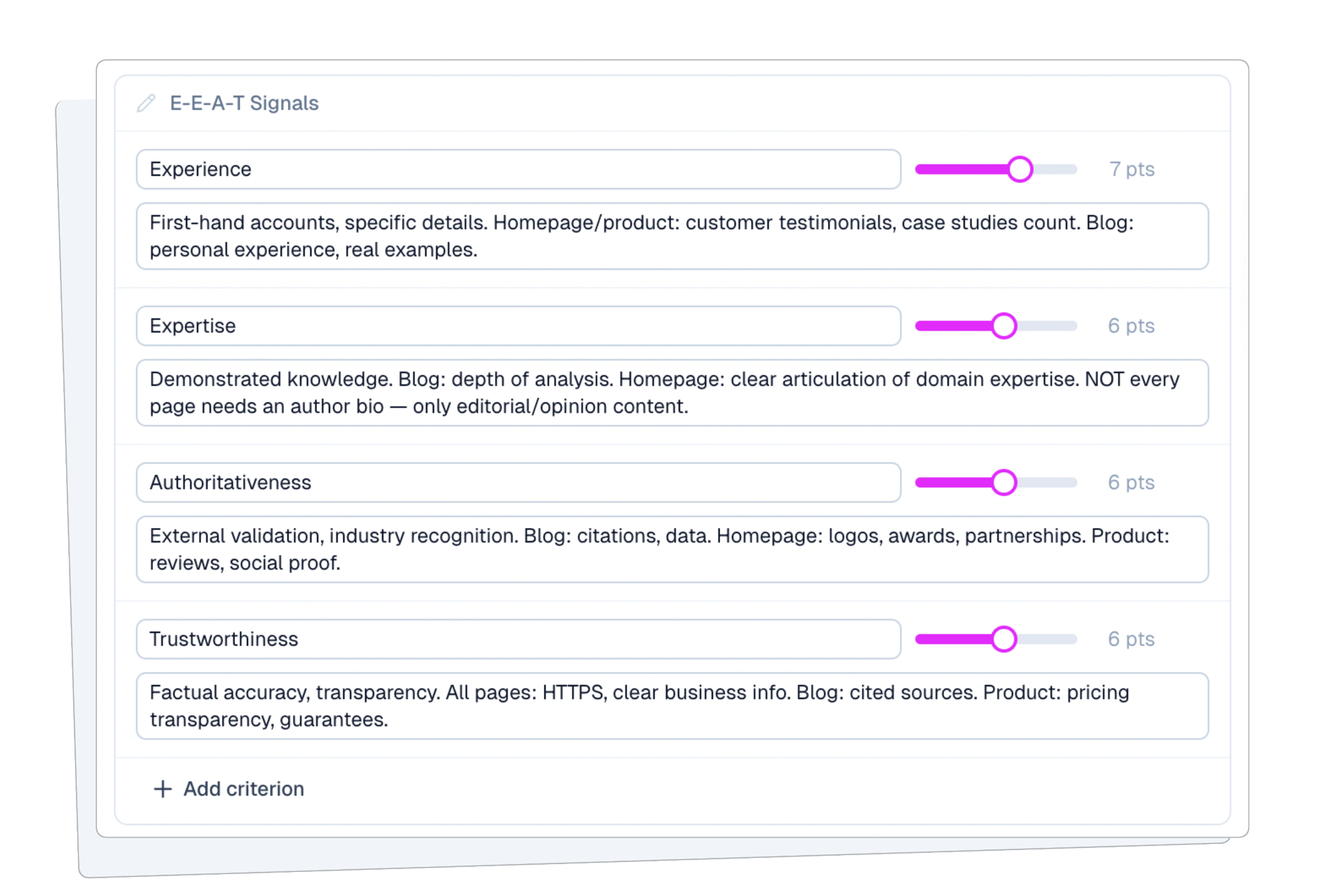
That means the content score is not simply a measurement of how many terms you managed to squeeze into the copy. It is a structured review of whether the page genuinely satisfies the search and competes with what is already ranking.
Once the suggestions are generated, we can choose which recommendations we want to use and create proposed edits.
I personally prefer to treat the generated copy as a starting point rather than something to publish blindly. We review the recommendations, make our own adjustments and ensure that the finished page sounds like the client.
Again, MetaMonster accelerates the judgment process. It does not eliminate it. When the draft is ready for approval, we can send the client a shareable link showing the proposed changes before anything is published.
This creates a much clearer approval experience than emailing a document full of disconnected edits or asking the client to trust that we are “optimizing” the page somewhere behind the scenes.
How MetaMonster Improves Client Reporting
Reporting has historically been one of the hardest parts of SEO delivery. A great deal of SEO work happens behind the scenes. Even when the work is valuable, clients may struggle to understand what changed or why it mattered.
MetaMonster gives us visible records of the work. Depending on the project, we can show clients:
- Their original and proposed metadata
- Keyword assignments for each page
- Content scores and recommendations
- Internal-linking opportunities
- Alt-text updates
- Before-and-after changes
- Implementation progress
Instead of giving clients a vague update that says, “We worked on on-page SEO this month,” we can point to the exact pages, recommendations and changes involved.
This is also useful internally. It gives my employee and me a shared record of what has been completed, what is awaiting approval and what still needs to be implemented.
Better reporting is not just about making prettier documents. It reduces confusion, improves accountability and makes the value of the work easier to understand.
How We Use MetaMonster for Lead Generation
This may be my favourite use case because MetaMonster helps us serve current clients and attract new ones.
When we run a new website through MetaMonster, the first screen provides an accessible overview of the home page, including:
- A content score
- Quick suggestions for improving the page
- Fast facts about other important pages on the website
We intentionally made this report shareable so that agencies can use it as a low-barrier lead-generation tool.
Here is how I use it at HelloSEO:
- A prospect fills out a form on my website.
- I run the website through MetaMonster.
- I record a short explainer video adding context to the report.
- I send the report and video to the prospect.
This works because the prospect receives something useful before being asked to make a major commitment. They can immediately see that we understand their website, recognize opportunities and have a thoughtful process.
Before MetaMonster, I used another SEO report-card tool to run a similar lead-generation strategy. From 2022 to 2024, that offer generated more than $500,000 in sales for HelloSEO.
The funnel was remarkably effective. Of the 214 people who received a report, 124 booked a call (a 58% booking rate) and 85 ultimately became clients, resulting in a 40% lead-to-client conversion rate.
It was not only effective because the reports identified SEO opportunities. They also helped prospects build trust and rapport with me before we ever spoke. By the time many of them reached the sales call, they would say, “I feel like I already know you!”
The strategy was already proven. MetaMonster now allows me to deliver it using a report that is more useful, customizable and closely connected to the services we actually provide.
It is a relatively low-effort way to provide meaningful value, demonstrate expertise and begin building a relationship before asking a prospect to make a major commitment.
From Overworked Founder to Agency Owner
I have worked in SEO for more than a decade, and the industry is changing faster than ever. The future does not belong exclusively to the biggest legacy platforms or the agencies with the largest teams. It belongs to businesses that can adapt quickly, build smarter systems and use automation without replacing the expertise that makes the work valuable.
That is what MetaMonster has allowed me to do at HelloSEO. It has not made SEO automatic. It has made my process visible.
It has not replaced my employee’s judgment. It has given her a stronger framework for applying it.
It has not removed me from the agency. It has removed me as the bottleneck. I am incredibly proud to build both HelloSEO and MetaMonster alongside people who care deeply about solving real problems for their users.
If you would like to see how MetaMonster could fit into your agency’s workflow, book a demo with me! I would love to show you how we use it, answer your questions and talk shop.