
Jade Pruett is the founder of HelloSEO, an SEO agency specializing in SEO/AEO for therapy practices. She is also the newest cofounder of MetaMonster.
Full disclosure: my agency used Clearscope until we built MetaMonster. Clearscope is a powerful option. The reason we built something new is that the two products go after content optimization in very different ways, and we wanted to create something that brought content optimization into the modern age of search.
As a content optimization tool, Clearscope has earned its reputation. You get a clean editor, a letter-grade content score, and a list of keywords your competitors use that you don’t. It’s easy to pick up, the support is good, and it drops into Google Docs and WordPress easily.
After months of using it, we kept hitting the same ceiling. Clearscope tells you which keywords to add. It doesn’t tell you whether the content is any good. And now that E-E-A-T signals, AI Overviews, and other technical elements shape what ranks, keyword coverage on its own won’t get you there.
So we built MetaMonster’s content grading to look at a lot more than just keyword count.
Keyword lists vs. a real content rubric
Clearscope reads the top results for your target keyword, pulls the terms those pages use, and grades your draft on how many you’ve worked in. It’s NLP-powered and useful, but the loop it puts you in comes down to one instruction: use more of these words.
MetaMonster grades against a multi-dimensional rubric built to mirror how search algorithms actually weigh a page.
Clearscope grades on:
- ✓ Keyword term coverage
- ✓ Word count vs. competitors
- ✓ Topic coverage vs. SERP
- ✗ E-E-A-T signals
- ✗ Search intent alignment
- ✗ AEO / AI Overview readiness
- ✗ Heading structure and H1
- ✗ Internal linking quality
- ✗ Clear CTA presence
- ✗ Author and brand credibility
- ✗ Vivid, trust-building language
MetaMonster grades on:
- ✓ Keyword in title, H1, and meta description
- ✓ Secondary keywords in H2s
- ✓ Natural keyword integration
- ✓ Factual accuracy
- ✓ Trust and authority signals
- ✓ Search intent alignment
- ✓ SERP and competitive position
- ✓ Missing keyword gaps with volume
- ✓ SERP feature opportunities
- ✓ Author and brand credibility
- ✓ Clear CTA and internal linking
- ✓ Metadata optimization
The difference between Clearscope and MetaMonster lies in their underlying philosophies, rather than a simple feature comparison. Clearscope optimizes for keyword coverage. MetaMonster looks at the whole page: whether the intent matches, whether the author reads as credible, whether there’s a clear next step, whether it holds up against the rest of the SERP, and whether it’s structured cleanly enough to get pulled into an AI Overview.
Holistic suggestions, not keyword counts
When Clearscope flags something, the fix tends to take the same shape: use this term more, or use it less (but mostly more.) That helps if you’re a writer who wants guardrails. It doesn’t explain why a page isn’t ranking.
MetaMonster’s suggestions go at that question directly. The SERP Analysis section tells you which topics competitors cover that you’ve skipped, how your content depth compares, and where the SERP feature openings are, like featured snippets and People Also Ask boxes. The E-E-A-T section checks whether your author credentials are actually visible, whether trust signals are present, and whether your language is specific enough to earn Google’s confidence.
Example: MetaMonster SERP analysis output
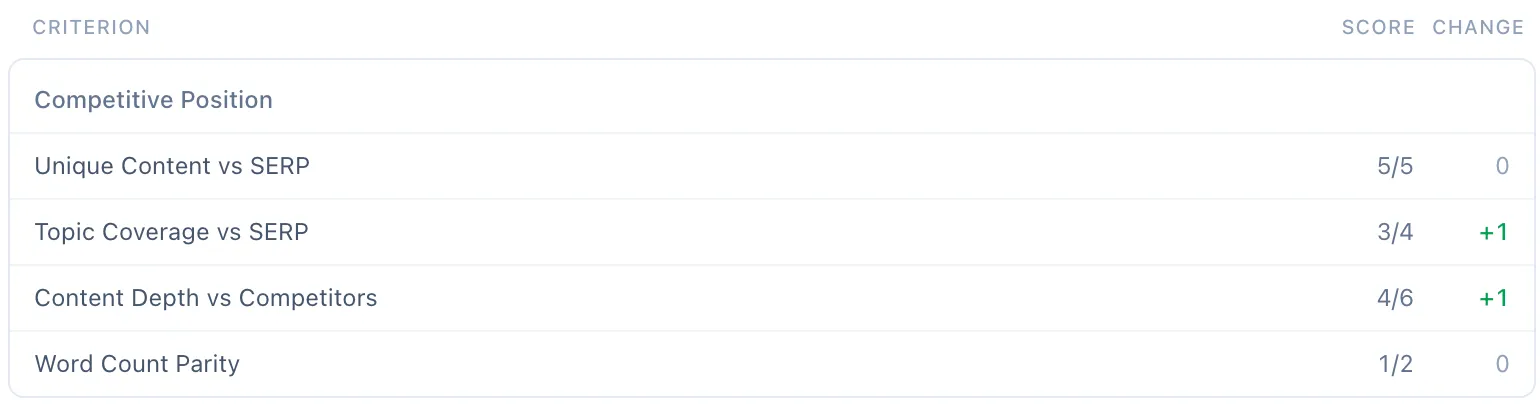
Every one of those scores comes with specific feedback you can act on, not a pile of keywords to stuff in. The point is to work out why a page is underperforming, not just to catalog what the top results happen to say.
Built for SEO and AEO, not just traditional search
The biggest change in search right now is AI Overviews and AEO. Google has moved past simply ranking pages. It pulls answers straight into the SERP, and the pages it draws from tend to have a few things in common: clear structure, credible authorship, and a direct answer to the question being asked.
Clearscope was built for traditional keyword-based SEO, and it’s solid at that, but it has no framework for judging AEO readiness or AI content optimization. MetaMonster’s rubric was designed for both. It checks whether your headings are set up to answer questions, whether your content has the kind of specificity that gets cited, and how your page stacks up against the snippets and People Also Ask boxes already sitting in the SERP.
In fairness to Clearscope: it’s still an excellent tool for writers who want clear feedback inside the editor as they draft. If in-the-moment keyword guidance is what your team needs most, it’s hard to beat.
Pricing
Clearscope’s Essentials plan starts at $129/month and Business runs $399/month, with pricing that scales as you add usage and seats. MetaMonster’s Starter plan begins at $149/month, while its Business plan runs $399/month. Because every MetaMonster plan includes unlimited users and unlimited sites, it is uniquely suited for agencies juggling multiple clients compared to a single content team.
Other Clearscope alternatives worth knowing
Surfer SEO. Surfer bundles content optimization with an AI writing assistant and a keyword research tool, so you get a wider toolset than Clearscope and a lower entry price (around $99/month, against Clearscope’s $129). The upside is having more tools under one roof. The downside is that the editor can feel busy, and the optimization logic still leans on keyword density and term coverage rather than broader page-quality signals. It’s the best fit for content teams that want one place to draft and optimize without paying enterprise rates.
Frase. Frase is strongest at the research-to-draft stage. It pulls SERP data, auto-generates content briefs, and lets writers go from outline to draft without switching tools. That brief-to-draft loop is the main reason to reach for it. The trade-off is that its optimization scoring is fairly shallow next to tools built specifically around SEO grading. Teams that publish in volume and want to speed up briefing and drafting will get the most out of it.
MarketMuse. MarketMuse is built for content strategy at scale. Its topical authority modeling, content clustering, and pillar planning go well past what Clearscope and most other tools attempt, and the depth is real: if you’re building a content program across hundreds of pages, the authority gap analysis earns its keep. But it’s pricey. There’s a free tier and an entry plan around $99/month, but the tiers that actually unlock the strategy depth run from roughly $249 to $499/month, with custom enterprise pricing above that. It’s the right call for in-house SEO teams running large content operations with the budget to match.
Semrush Writing Assistant. If your team already lives in Semrush, the Writing Assistant is a handy add-on. It checks readability, tone consistency, and keyword usage without making you leave the platform. The limitation is that it’s a thin grading layer sitting on top of a product built for keyword research and rank tracking, not a purpose-built optimization tool. Best for Semrush users who want basic content checks without taking on another subscription.
Try MetaMonster’s content grader
See how your pages score across SEO fundamentals, E-E-A-T, SERP competitiveness, and AEO readiness, not just keyword coverage.
Stop chasing keyword counts. Start improving content.
Add your site, analyze your pages, and get content recommendations that read well. For one page or your entire site.
Optimize your homepage, or plan the copy for a new site. One page free, no card.