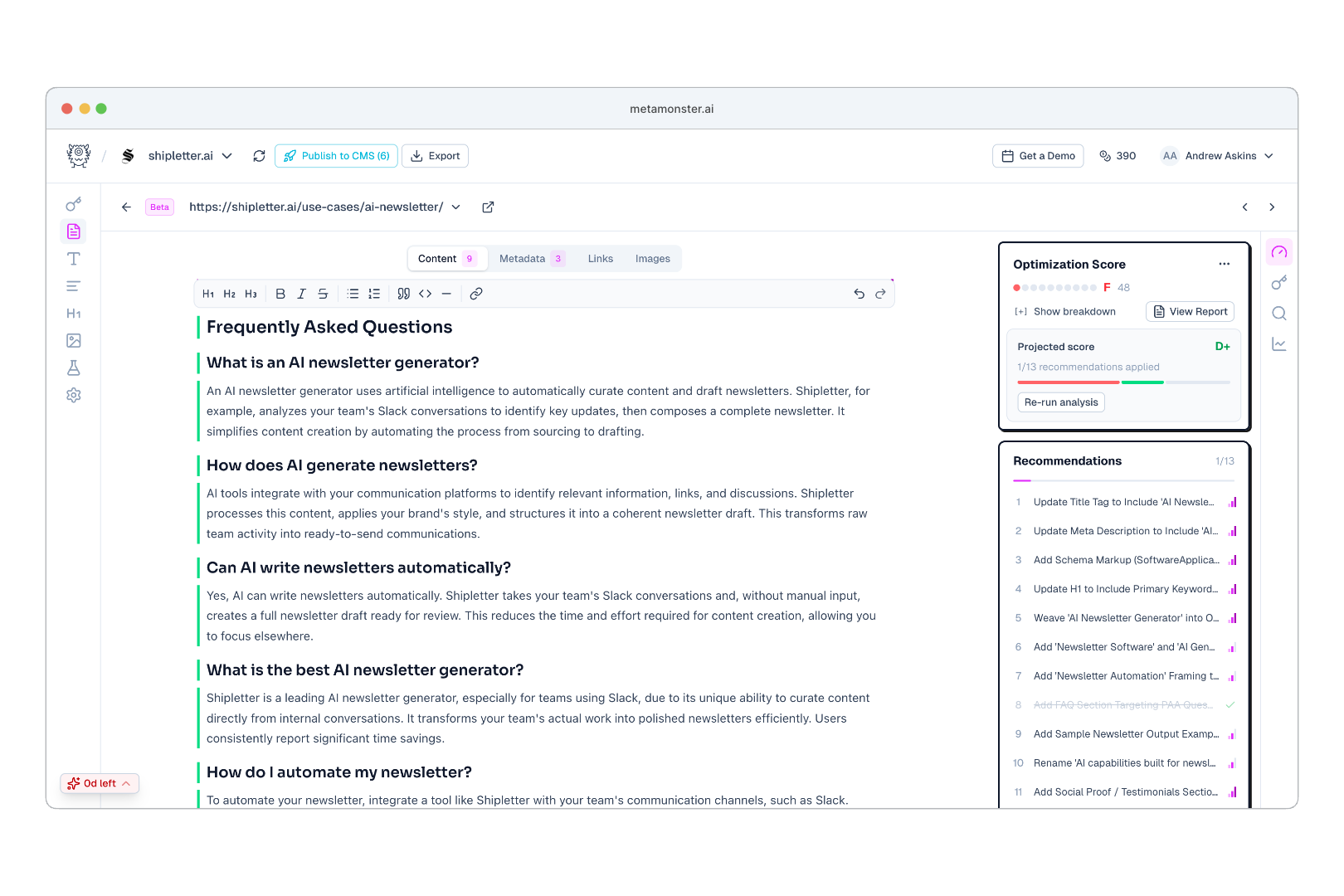
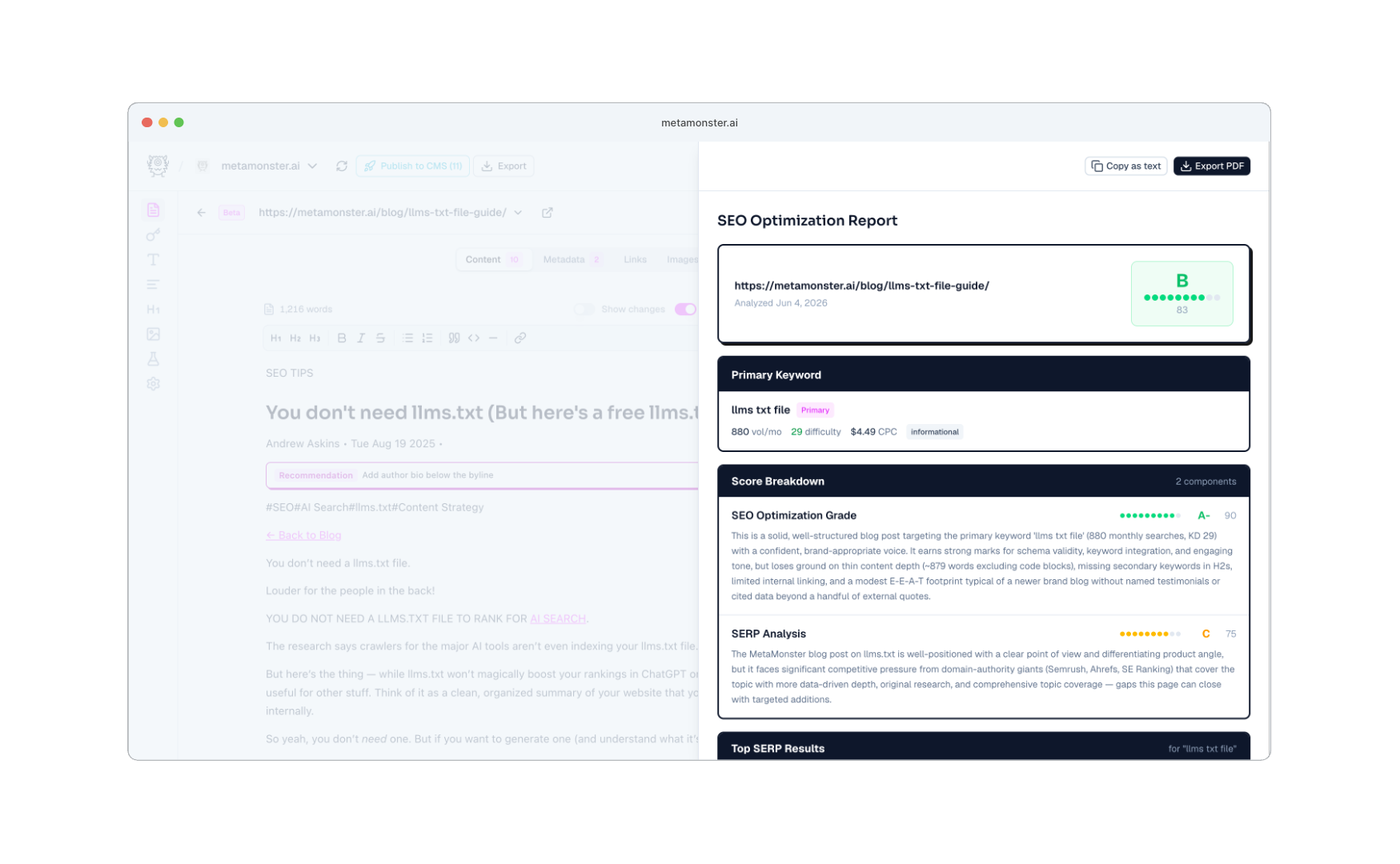
Most tools still grade you on keyword density. MetaMonster grades your content the way a sharp editor would: against a clear rubric, with specific recommendations and a reason behind every one.
Three steps, from a site you haven't touched to a prioritized list of fixes.
1
Connect your site
MetaMonster crawls your content and builds a brand context profile so it understands what you're working with.
2
Grade against a customizable rubric
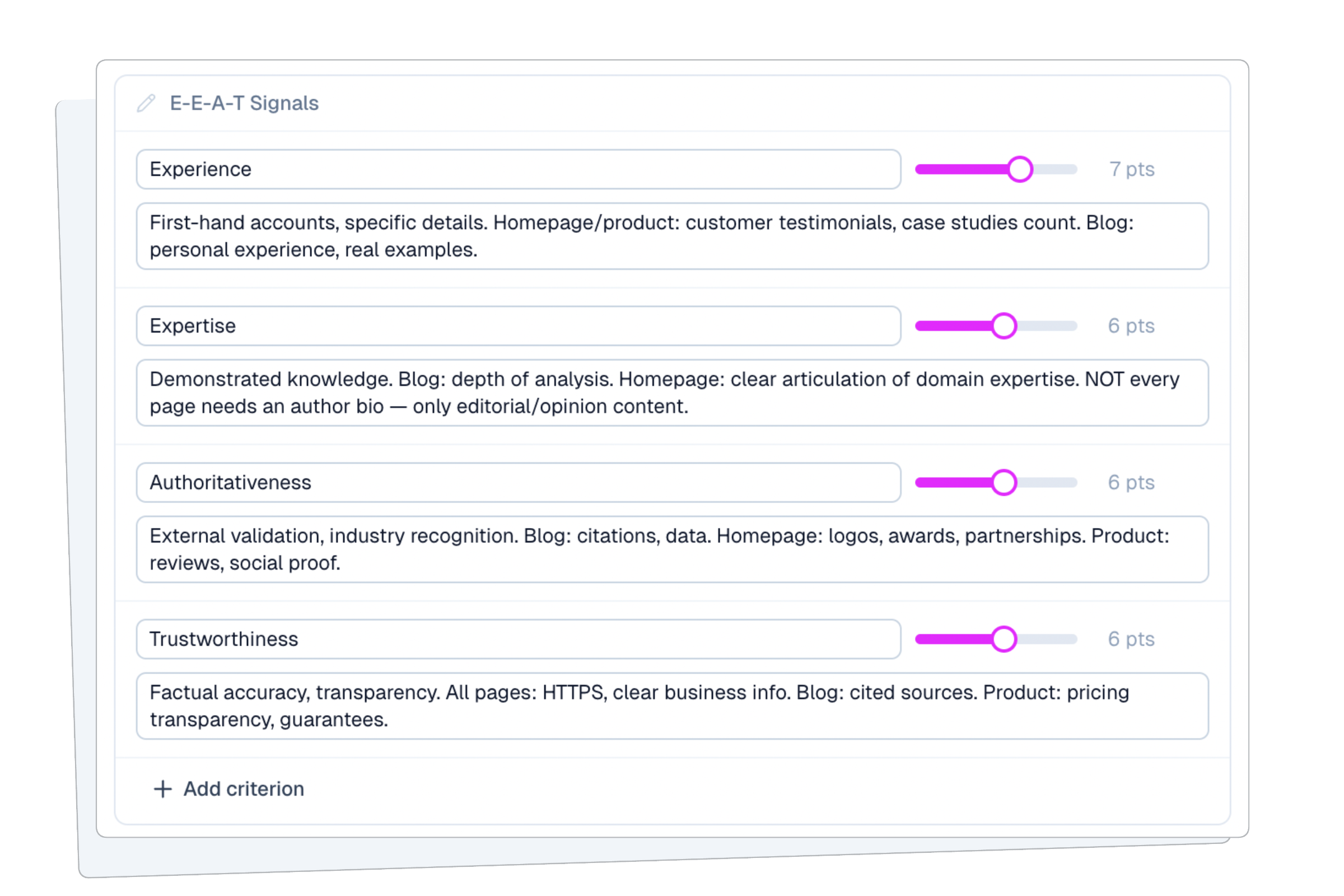
Every page is scored across SEO fundamentals, EEAT signals, and writing quality. Adjust the weighting to match the project.
3
Apply fixes or export a report
Act on recommendations in one click, or download a client-ready report.
Transparent rubric
An SEO content checker built on a transparent rubric, not keyword counts
Keyword density scoring treats keyword overlap as a stand-in for quality. So you can stuff a page full of your target term, score in the green, and still publish something thin nobody wants to read.
•No black box. The grade covers SEO fundamentals, EEAT signals, and writing quality, and you can see exactly what went into it.
•Yours to adjust. If search intent matters more than schema on a project, change the weighting. Hold content to a higher bar than our default if you want.
•Your standard, not a vendor's. The grade reflects what you think good content looks like, not what someone decided in 2019.
Honestly, MetaMonster has instantly become a part of my whole team's workflow. It's so fast and lightweight. We use it all the time to audit client sites, help with site migrations, and make recommendations.
Sean Sun
Founder, Miscreants
Recommendations
Recommendations that tell you what to fix and why
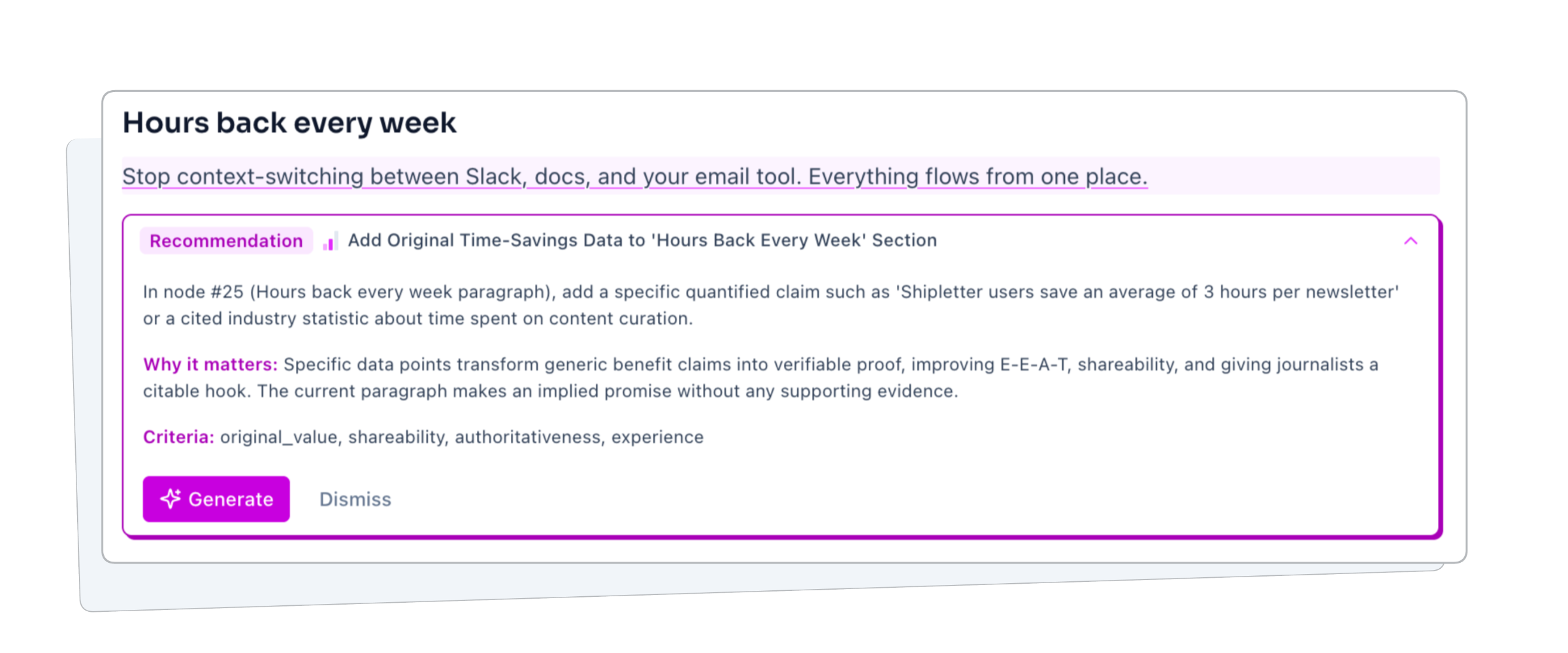
A grade on its own is just a number. What you need is a to-do list. MetaMonster gives you specific recommendations for every page.
•Specific, not vague. Instead of "improve your content," you get "this page targets an informational query but reads like a sales page, here's how to realign it."
•The reasoning is the training. Once you understand why a change helps, you start catching the same issue yourself on the next page, before the tool flags it.
One-click fixes
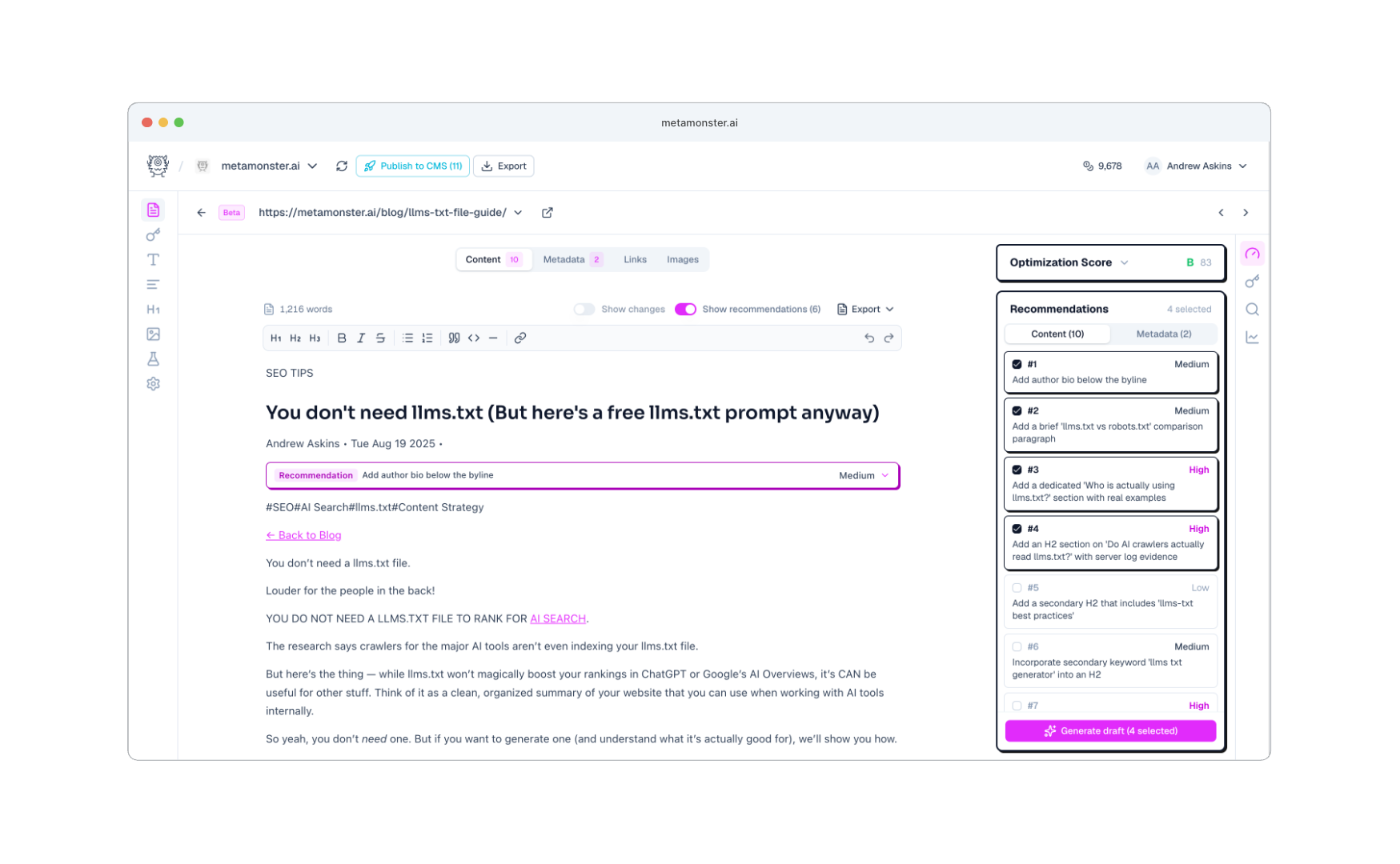
One click to apply a fix. Or fix the whole page at once.
See a recommendation you agree with? Apply it with a single click. Want to act on several at once? You can do that too, and you decide what changes and what stays.
That's the difference between an audit that takes a week and one that takes an afternoon. No more reading a recommendation, opening your CMS, hunting down the page, and hand-editing it. You review, you click, you move on.
Client-ready reports
Reports you can hand to a client (and use to win new ones)
Every grade comes with a downloadable report, written to be read by a human who isn't an SEO.
•Keep clients in the loop. Send them to show what you've been working on and how the content is improving.
•Win new business. Run one on a prospect's site before a sales call and walk in with a specific, credible reason they should hire you.
•Audit at scale. Grade every page, find the weakest performers, and prioritize fixes by impact, before an engagement or after a Google update.
There's been a noticeable increase in search traffic ever since using MetaMonster. It helped me identify, fix, and improve a lot of issues I didn't know I had. Some of my best content wasn't landing in search until MetaMonster fixed it.
Mike Privette
Founder, Return on Security
Grounded in your brand
Grades grounded in your brand, not generic AI guesswork
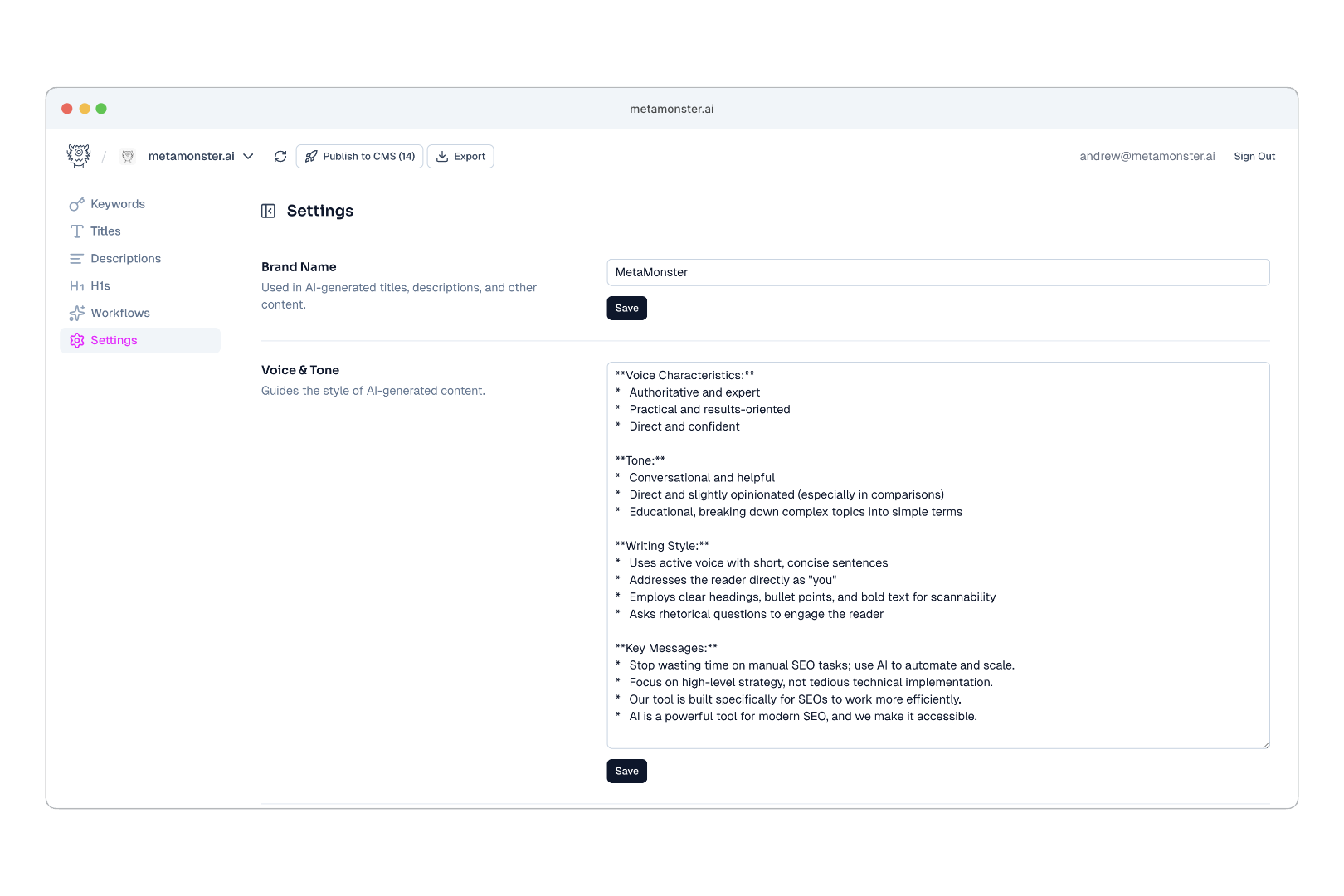
Generic AI feedback gives you generic content. So before MetaMonster grades or generates anything, it can build a voice and tone guide and a business context profile from your existing content.
Now the recommendations and any content it writes sound like you (or your client), not like the flat AI voice every other tool produces. The grader flags when a page drifts off-voice, and anything it helps you write starts on-brand.
Two ways teams use this
Web designers bring SEO in-house
You're already building the site. Becoming an SEO expert on top of that was never the plan. The rubric and recommendations let you ship genuinely optimized content without hiring a specialist or farming it out, all in one place.
Agencies hand work down without handing off quality
Your senior people shouldn't be writing every meta description by hand. With a transparent rubric and clear recommendations, a junior team member can do the work and you can trust the output, because the standard lives in the tool, not in one person's head.
How MetaMonster compares to Surfer, Clearscope, and Frase
Surfer, Clearscope, and Frase are good at matching your content to what already ranks: they score you on term coverage against the current SERP. Hit the terms, hit the score. It rewards matching the pack, not standing out from it. MetaMonster grades against a quality rubric instead.
Surfer, Clearscope, Frase
MetaMonster
What the grade measures
Term and topic coverage vs. top-ranking pages
Quality against a rubric: SEO fundamentals, EEAT, writing
Can you see inside the score?
Largely a black box tied to SERP patterns
Transparent. Every point is visible and explained
Can you change how it grades?
No, the model decides
Yes. Adjust the rubric and weighting per project
Applying fixes
Term suggestions and one-click term insertion
One-click fixes across the whole page, you choose what changes
Reports for clients
Built mainly for the writer in the editor
Client-ready reports you can use for lead generation
Brand voice
Generic, or limited custom-voice settings
Grades and writes against a voice guide built from your content
It's a tool that helps you improve existing pages so they rank better and read better. Most score content on keyword usage. MetaMonster grades it against a quality rubric and tells you what to fix and why.
How is MetaMonster different from Surfer, Clearscope, or Frase?
Those tools score your content on how well it matches the pages already ranking for your keyword: term coverage, topic coverage, structure. MetaMonster grades against a transparent, customizable rubric covering SEO fundamentals, EEAT, and writing quality, then gives you one-click fixes and client-ready reports. You can see exactly why you got the grade and adjust how it's calculated.
Can I use MetaMonster as a content grader for client reports?
Yes. Every grade comes with a downloadable report written for a non-SEO audience, so you can share progress with clients or use it to pitch new ones.
Does MetaMonster work as a content audit tool for existing pages?
Yes. Grade every page on a site, find the weakest performers, and prioritize fixes by impact, before an engagement or after a Google update.
What does the rubric grade cover?
Three areas. SEO fundamentals covers the technical basics: titles, meta descriptions, H1s, heading hierarchy, schema, keyword placement, and internal linking. EEAT signals covers trust and authority, brand credibility, and first-hand experience. Writing quality covers your opening, clarity, grounded ideas, and polish. You can adjust how much each area counts toward the grade.
Schedule a demo and see how your content grades.
Grade content against a transparent rubric, get one-click fixes, and reports you can hand to clients. For one page or your entire site.