MetaMonster put one question to 17 SEO and digital marketing professionals from across our community: what are you actually seeing work for AI search right now, with your own clients? Not theories, not speculation, not stuff they heard at a conference. Real results, real data, real patterns.
Here’s what they said.
TL;DR
Win at the fundamentals, build authority everywhere your audience looks, make your content trivially easy for machines to understand, and measure what’s actually happening rather than chasing the hype.

Joanna Booth
Managing Director, Organic Growth Team
To win in AI search you still need to have a performative website that is easy to understand and points to your core concepts and USPs clearly. Technical SEO foundations, CWV work, and highly focused on-page optimization is still key. Focus on how LLM agents actually find and interact with relevant content and brands in your space. Audit the topics you want to show up for, find out who is showing up for them, and understand what pages are getting cited in your competitive space. Your owned content will drive a lot of what shows up in an LLM answer. So, once you have a clear idea of what content is working for brands who are mentioned and cited more than you you can start to build out a strategy for your site to win. EEAT is still mega important, but now we are also seeing 3rd party reviews, community mentions, and write ups take a lot of weight. It’s more exciting than ever to be in search, but the search game has definitely added a lot of new layers that you need to be exploring in order to win not only in the SERPs/A/O’s but also the LLMs - as more and more people are starting and finishing their query journey there.

Meg Clarke
Owner, Clapping Dog Media
The biggest signal we’re seeing is that structured authority content is outperforming traditional keyword-optimized content in AI citations - by a lot. Clients who have a clear point of view on a topic, documented in long-form, are getting pulled into AI answers. Clients with thin, keyword-stuffed pages are invisible.

Shweta Gupta
Founder, Growwdigitaly
Honestly, the clearest signal: being consistently mentioned across multiple surfaces matters more than any single tactic. Forums, reviews, third-party publications, community conversations. Brands with real presence there are the ones showing up in AI answers.
What is showing early traction: Prompt analysis. Reengineering long-tail prompts to find the head terms LLMs associate with a topic, then optimising around those. Forum and community content. Reddit, Quora, niche communities. LLMs cite these heavily. Presence there is starting to show up in AI answers.
What is not working: volume content without authority signals, and treating LLM visibility as separate from SEO fundamentals. The brands getting cited were already doing the basics well. Still early. Anyone claiming they have fully cracked it is selling something.

Tony Danger
Founder, WISLR
I love this prompt and I’d like to use it to illustrate a point. It’s hard to pin down AI strategies that are going to work for every website or even long term with the rapid changes to LLM surfaces. The most important thing is that every organization establishes some workflow or process to gather their own insights about AI. Don’t take someone else’s share-out as truth. Try it for yourself. Test and learn if it has legs for your industry or niche. And if the experiment wins or even loses, don’t take one data point as truth either. Try to repeat the results.
Specifically, here’s one thing a brand can test for themselves for a content strategy to capture greater Share of Voice in the models: translate your LLM content into the language of the region your customers are coming from. 20% of WISLR referral traffic from LLMs (~1,400 users in the last 90 days) land on our translated pages. If you’re already made the content in English, find a way to spin it out into other languages (we always translate into 12 non-English dialects). This effort doesn’t move the needle as much in organic search (Search Console data) but it shows great activity from the LLMs (which we verify with our own LLM Traffic Monitoring tool).

Dena Warren
SEO Lead, Techquity
I’m putting more emphasis on data-led content that is unique to the business, such as data trend reports and offering that unique perspective, to demonstrate E-E-A-T. From what I have seen this is helping position the brands and I am seeing increases in citations and referrals from AI search. For one client, since January 2026 I have seen a 50.2% increase in sessions from LLMs and a 2.5% increase in events from LLM traffic.

Stephen Vernon
Founder, Base Hit Marketing
Most of my clients are local service businesses, not national brands. So my answer reflects that.
Question-driven content structure is the only thing producing a clear signal. Example: I rewrote a service page on one client using GSC query data. Restructured around actual questions, answered them directly in the opening. Daily impressions jumped ~175% in week one. Avg position moved from ~11 to ~7. I also published a new FAQ page the same day on the same site. Indexed in 2 days. 238 impressions in week one. One of the visible queries was a full natural-language sentence. LLM-shaped, not something a human types into Google.
What I’m not seeing yet: meaningful LLM-referral traffic in GA4. Impressions are a leading indicator. Referral traffic is lagging.
What’s clearly not working, in my opinion: schema-heavy ‘AI optimization’ packages and generic content rewrites. How are you answering a real question with a real answer? I’ve seen these similar patterns for other clients as well. Just one use case within the last month.

Andy Strager
Senior SEO Consultant, Uproer
Brand protection should be center stage right now. Trying to show up for every AIO is meaningless if the brand sentiment is junk. Dialing in on brand analysis queries and creating content to improve sentiment is something that I have been seeing work across the industry, and even with my own clients. Content has always been a massive play in search, but the types of content we are producing need to evolve. If you don’t control your brand narrative, someone else will.

Pooja Muhuri
Founder, Faro Index
Schema markup is the single clearest lever I am seeing move AI accuracy right now. Not hearing about it theoretically. Seeing it in the data.
I built an AI brand accuracy scanner that checks how ChatGPT, Perplexity, Gemini, and Claude describe companies to buyers. I have scanned 244 companies across 11 industries. The pattern that keeps repeating: companies with structured data on their homepage score 7 points higher on brand accuracy than companies without it. 76 percent of the companies I scanned had zero schema markup.
The specific wins I am tracking: companies that added Organization JSON-LD with explicit category declarations saw accuracy improvements on Perplexity within 2 weeks and on ChatGPT within 4 to 6 weeks. FAQ schema on pricing pages had the fastest measurable impact on GEO score, averaging a 12-point improvement within 4 weeks.
The finding that surprised me the most: there is near-zero correlation between AI visibility (how often AI mentions a company) and AI accuracy (whether what it says is correct). A company can score 96 on visibility and 57 percent on accuracy. AI mentions them in almost every response and gets nearly half the facts wrong. Visibility without accuracy is a false signal.
The other pattern worth noting: companies with common English word names (Bench, Pilot, Greenhouse, Writer) have significantly worse accuracy because AI resolves the name to its most common meaning in training data. Bench becomes gym equipment. Greenhouse becomes agriculture. The fix is disambiguation content in the first paragraph of the homepage plus Organization schema with explicit sameAs and description properties. That takes under an hour to implement.
Google published guidance on May 15 saying GEO is “still SEO.” For Google AI Overviews, that is accurate. For ChatGPT and Perplexity, the data tells a different story. Those platforms weight structured data differently, and companies optimizing only for Google are missing the platforms where buyers are increasingly doing their research.

Sean Barber
Host / SEO Manager, Search With Sean / Macmillan Cancer Support
In the health sector, we are seeing misinformation spread faster than ever before. To help combat this, we have focused on strengthening and clarifying our on-site and off-site authority signals for both users and AI models alike. We have also created content that directly addresses misinformation to help educate users on what is right and wrong from a trusted and authoritative publisher.
At the same time, we understand this is not something we can tackle alone. Internally, the SEO team is now working much more closely with teams across paid, social and PR. Externally, we are collaborating with organisations such as the Patient Information Forum and other charities to help create content and campaigns that push back against health misinformation. This has also included digital PR activity which, so far, has been very effective - leading to coverage in publications such as The Guardian and The Independent, alongside millions of views across campaigns and content.

Ebere Cecilia Jonathan
Founder, Search Africon
I noticed that pages with content vignette at the top or bottom of an article are showing stronger visibility in AI-driven surfaces (like Google AI Overviews and other answer engines) as it makes it easier to get a summary of the page content without having to go through the entire content. This I have also found to be a useful UX feature.
I also noticed that brand mentions are becoming a proxy for trust in AI retrieval. Even without backlinks, Search Africon is constantly cited by answer engines when it gets queried on “the best African SEO event” that’s due to consistent mentions across the web (forums, LinkedIn, PR, niche blogs).
Business that has built authority or get mentioned often are cited more by AI engines.

Garrett Sussman
Director of Marketing, iPullRank
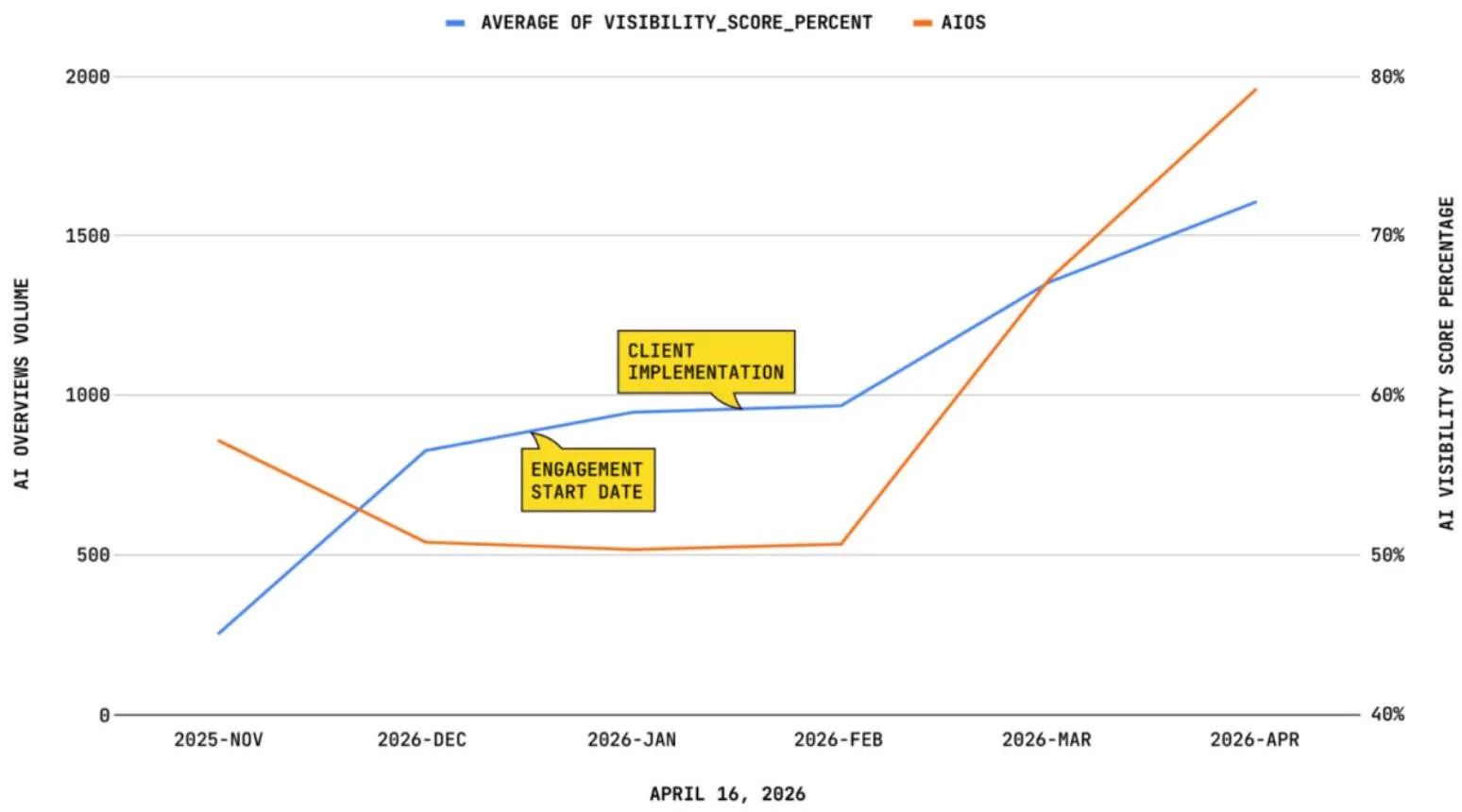
We ran a focused AI Search pilot built to drive early gains in 3 months. First, we addressed technical issues that were limiting discoverability by fixing 499 errors, correcting global navigation headings, and updating robots.txt. Then we delivered the strategic and measurement work needed to support ongoing performance: a Keyword Portfolio, Omnimedia Content Audit, Omnimedia Content Plan, AI Search Measurement Plan, AI Search Audit, and Strategic Roadmap.
- 278% Increase in AI Overview Visibility
- 21% Increase in AI Referred Revenue
- 34% Increase in AI Search Visibility

Stephanie Long
CEO / Founder, Mrs. SEO
What I have been seeing work with AI clients is embedding videos in their blog posts. AIO and AI Mode are favoring content that has multi-media in it, and I have already seen an increase in AI visibility for clients that I have implemented this strategy for.

Ila Bandhiya
Senior Digital Marketer, Middleware
What we’re seeing work right now is a combination of LLM-friendly content optimization, stronger E-E-A-T signals, and strategic brand-focused authority building.
Over the last few months, we’ve updated existing articles by adding TL;DR summaries, direct answers, FAQs, and clearer content structures that make information easier for AI systems to understand and extract. We’ve also started analyzing the types of queries that consistently trigger AI Overviews and adjusted our content to better match those search intents.
Another area that’s delivered results is building out knowledge base and educational content with strong E-E-A-T signals. Instead of focusing only on commercial content, we’ve invested in authoritative resources that demonstrate expertise and provide comprehensive answers. Several of these pages have started ranking well and gaining visibility in AI-driven search experiences.
We’ve also put more emphasis on brand keyword link insertions and brand authority, helping search engines and AI systems better associate our brand with specific topics.
In terms of results, we experienced a significant traffic decline from around 30,000 monthly organic visits to about 5,000 as search behavior shifted. After implementing these changes, we’ve recovered to approximately 12,000 monthly visits and continue to see gradual improvement. While we’re still testing and learning, the strongest signal so far is that content that is easy for AI to summarize, backed by clear expertise, and supported by strong brand authority tends to perform best across both traditional search and AI search experiences.

Kelly-Anne Crean
Head of Operations, Koozai
Across a number of clients, we’re now seeing AI search, particularly ChatGPT, act as a genuine acquisition channel rather than just an early-stage research tool. In some cases it is already contributing to assisted conversions, which suggests users are further along in their decision journey than typical organic traffic.
In terms of what is working, the patterns are fairly consistent. Pages that perform best tend to have expanded FAQs that reflect real decision-based queries, clear table-led comparisons for things like pricing and features, and strong internal linking that helps build topical context across related content.
Where we can segment this traffic, we are also seeing AI-referred users convert at a higher rate than traditional organic search in several instances, although volumes are still developing and patterns are early. Overall, the strongest gains come from making content easier for systems to extract, compare, and reuse rather than relying on long-form narrative alone.

Julia Bocchese
SEO, Pinterest, + AI Search Strategist, Julia Renee Consulting
Foundational SEO work is always helpful with AI search, and I’ve also been working with my clients on finding ways to add quick information to their pages and blog posts. We’re doing things like adding FAQs to services pages and summaries or TLDrs to their blog posts. And we’re making sure the meta descriptions are optimized well for both SEO and AI platforms. These are easy updates that can have quick wins for my clients, and bonus, they’re helpful for their potential clients who want quick information, too! They’re also easy to create because you can go to AI platforms and ask directly what types of FAQs would be beneficial for AI search, so you can get the information directly from AI itself (but make sure everything is aligned with the client’s brand and target audience, of course!).

Melissa Popp
VP of Content Strategy & Innovation, RicketyRoo
The brands I’m seeing win in AI search are the ones answering real questions with actual expertise, not thin “AI optimization” plays dressed up as strategy. For clients, the strongest gains come from content that connects entity signals, draws on first hand experience, offers original examples, and tightly matches intent. The best results come when we clean up messy content ecosystems, build useful topic depth, and make the brand easier for both humans and machines to understand. It’s not flashy, but it works.
Janna Pugh
SEO Enthusiast and Public Speaker, Independent
I have seen a lot of volatility in recent months, as many others have, with seemingly endless algorithm updates and fickle LLM ranking factors affecting not only traditional SEO success indicators like keywords or backlinks, but also onsite traffic and conversion metrics. Like all SEO-ers know, the traffic, the users, and the demand is still there. It has just become harder to document the users and to actually bring them onto the site to convert.
For me, I chose to formally take a dual approach to my organic search efforts. I still strongly believe traditional SEO best practices of a clean website and helpful content is still the king. In Q2, I implemented hundreds of individually selected keywords onto my website metas/copy and immediately saw increases to those keyword rankings and had a 73% increase to new users within the month.
However, in tandem with the traditional SEO efforts, I have started ‘digital brand footprint’ building. I started using this phrase because it is becoming more apparent by the day that in the LLMs and Google’s new SERP structure, your brand’s primary website is only a piece of their considerations. In the pre-AI search world, a website was the golden place of truth and was where SEO efforts were concentrated. Now, we are able to paint a larger picture of a brand across our reviews, social media, press coverage, forums, videos, and anything else search engines continue utilizing.
The greatest success I have seen has been in this offsite brand building. Not backlinks, but building brand authority away from the primary domain. Things like YouTube, LinkedIn articles, PR and earned media, and creation of multimodal collateral like branded infographics. These initiatives are more nebulous in terms of ROI and efficacy, so the changes in AI search have altered the way I report on my work. Instead of the holy trinity of keywords, impressions, and conversions, I now focus more on SERP features, indexed pages across search platforms, and full website metrics for Direct, Referral, and Organic in GA4 to better tell the story I want to convey. Even though Organic Search metrics in GA4 tend to have large ups and downs these days, adding LLM referral traffic and other parameters into my reporting has helped to showcase where users are now coming from.
I know some people can feel lost or confused with the current state of SEO, but I really enjoy experimenting and the creativity that comes from the world of organic search!
What it all adds up to
Seventeen practitioners, one question, and a surprising amount of agreement. A few themes came through loud and clear.
The fundamentals didn’t go anywhere. Joanna Booth, Melissa Popp, Julia Bocchese, and Janna Pugh all made the same point in different words: clean technical foundations, helpful content, and strong E-E-A-T are still the price of entry. The brands Shweta Gupta and Melissa Popp saw getting cited were the ones already doing the basics well. AI search didn’t replace SEO; it raised the stakes on doing it properly.
Brand presence beyond your own domain is the new frontier. This was the single most repeated idea. Joanna Booth, Shweta Gupta, Ebere Cecilia Jonathan, Andy Strager, Sean Barber, and Janna Pugh all pointed to mentions, reviews, forums, PR, and community conversations as the signals that increasingly decide whether AI engines surface and cite you. As Janna Pugh put it, it’s brand authority away from the primary domain, not just backlinks. Andy Strager added a sharp warning: if you don’t control your brand narrative, someone else will.
Structure your content so machines can extract it. Meg Clarke, Stephen Vernon, Ila Bandhiya, Kelly-Anne Crean, and Julia Bocchese all reported real lifts from TL;DRs, direct answers, expanded FAQs, comparison tables, and question-driven page structures. Stephen Vernon saw impressions jump ~175% in a week after restructuring a page around real questions. Ebere Cecilia Jonathan noted content summaries up top help both AI and users.
Structured data and rich media are underused levers. Pooja Muhuri’s scan of 244 companies found schema markup measurably improved AI accuracy, especially on Perplexity and ChatGPT, and that 76% of companies had none. Stephanie Long saw AI visibility rise simply by embedding videos in blog posts.
The results are real and measurable. Garrett Sussman’s team drove a 278% increase in AI Overview visibility and a 21% lift in AI-referred revenue. Dena Warren saw a 50.2% increase in LLM sessions from data-led content. Kelly-Anne Crean is seeing AI act as a genuine acquisition channel, with AI-referred users converting at higher rates than traditional organic.
And a healthy dose of skepticism. Tony Danger’s advice anchors the whole roundup: AI surfaces change fast, so build your own measurement process and don’t treat any single data point, or anyone else’s share-out, as gospel. Pooja Muhuri’s reminder is just as important: visibility without accuracy is a false signal, and the two barely correlate. Several pros agreed on what’s not working: schema-heavy “AI optimization” packages, generic rewrites, and treating LLM visibility as something separate from SEO.
The throughline is simple, even if the execution isn’t: do the fundamentals well, earn authority across every place your audience shows up, structure your content so machines can lift the answers straight off the page, and let real measurement, not hype, decide where you invest next.